Header Image map

Home My Story Fancy Things Country Life Great Americans Entertaining Media/PR Contact Me Image Map
Showing posts with label land. Show all posts

Thursday, August 3, 2017

Stewards of the Land

The article below was published by our local newspaper, The Republic, in the monthly publication, Farm Indiana.  I am lucky to have the opportunity to write for the paper and share stories of our life on the farm.  This time the author did a wonderful job capturing our family and the long tradition of farming which I hope continues for generations to come.

Stewards of the Land
Trevor and Brett Glick find seeds of opportunity in diverse operations

By Barney Quick
Photos by April Knox

Two brothers in eastern Bartholomew County embody a formula for success based on diversification, strategic savvy, respect for legacy and gratitude for opportunity. They do so on land that has been in the family name since 1854.

Brothers Trevor, 37, and Brett, 35, have four activities that comprise their operation: commercial row-crop production, a seed company, beef production, and distillery grain production. They see growth potential in each, depending on trends and economic forces in the world in general.
Each went to Columbus East High School and then earned an agricultural economics bachelor’s degree from Purdue University. As is often the case in Midwestern farm families, farming got in their blood early on and was regarded as a way of life.


“We feel blessed to be able to farm,” says Trevor. “It’s not the kind of profession people generally get into without coming from a family that does it. That can be done, but it’s more challenging than being born into it. We see ourselves as stewards of what’s here for the next generation.”

There are a lot more Glicks in Bartholomew County, comprising three main branches that can trace a common ancestry in Pennsylvania. The brothers have cousins nearby who also run a seed company.
“We don’t really compete,” says Trevor. “That’s the charm of this area in general. The farmers have a strong sense of community. You don’t see the inclination to undercut each other that you do in some places.”

Both the commercial row crops (corn, wheat, soybeans) and the seed business are driven by meeting precise needs of customers.


“We have opportunities to license different genetics and traits and select corn and wheat varieties for unique characteristics for the soil in southeast Indiana and northern Kentucky, which is our customer base,” says Trevor.

Their corn is non-genetically modified. It’s sold through a broker. Some goes to the distiller market and some is exported. Japan and South Korea are two destinations for Glick corn.
The current iteration of the seed business has its roots in Glick Seed Service, founded by the brothers’ great-grandfather, Lloyd. His son, Lynn, founded Lynn and Myron Glick Seed Co. with his son, Myron, the brothers’ father. Myron passed away in 2005, and the brothers purchased his interest and later their grandfather’s too. The acronym version, L&M Glick, is the current name.
While consolidation in the seed industry has diminished the number of local companies, it’s been important to the Glicks to remain independent.


 “We get to choose what we provide to our customers,” says Brett.

Their beef operation currently consists of feeder calves. They are born in February, weaned in September and sold when they reach the 500- to 600-pound range. The customers finish the calves for another year. The calves aren’t pure bred, but, once again, attention to genetics is a top priority.
“We breed them for a calm disposition,” says Brett. “They’re easier to manage, and they stay fleshy with less food than less calm cows would. We’ll keep a heifer with good genetics up to 15 years.”
Adds Trevor, “We keep precise records on breeding, birthing, weaning and their weight when we sell them.”

For several years, they had a business called Brothers Beef that was a direct-sales operation. They ran a booth at the Saturday farmers market in downtown Columbus, but, according to Brett, it became a choice between that and “Trevor going to his kids’ soccer games.”


The distilled grains component of the Glick operation came about when the Spagnuolo family, owners of Bear Wallow Distillery in Brown County, approached the brothers.

“They said, ‘Hey, you know how to clean grain, and we want to work with someone locally,’” says Trevor.

That led to supplying other distillers with custom grain cleaning and a partnership with a rye importing business.

Strategic planning is an ongoing part of their activity. Five years ago, they conducted a major SWOT (strengths, opportunities, weaknesses, threats) analysis. Brett maps out a budget on a monthly basis.
He grants that it doesn’t come as naturally as the more hands-on aspects of what needs to be done: “I’d rather be out bush-hogging or cleaning fence rows, but you have to know your route for where you’re going. You have to take your eyes off the scenery and look down at the map.”
They play to their strengths. Brett handles the financial analysis, and Trevor does a lot of the customer relations work.

Lynn can be seen strolling the premises on most days, which shouldn’t be surprising, given that the brothers’ office and the equipment storage building are across the lawn from his house.
“Grandpa is our parts retrieval specialist,” says Brett.

They send him on missions to nearby equipment dealerships when something breaks down. Lynn notes that it gives him the opportunity to eat at restaurants in Seymour or Greensburg.
Brett and his wife, Katie, have one daughter, Mae. Trevor and his wife, Kelly, have three children, Sophie, Ethan and Eli. Brett says that their wives are “very supportive of our business but not directly involved.”


Their mother, Marybeth, lives in a house adjacent to the farming property. After raising her children (and occasionally helping with tasks like tractor driving), she worked at Cummins, from which she retired. She now helps with 4-H projects for one of her granddaughters, the child of the brothers’ sister, Lisa.

What is it like to live one’s entire life on one piece of ground and see the same faces daily in one’s professional life in an age when mobility is the norm for so much of society?

“There’s definitely something very valuable about being grounded,” says Brett. “We do travel and have social lives, but we hold that connection to the past in high regard. There’s a particular shovel I really like to use. It has a worn handle and probably isn’t as efficient as one I could go buy at Rural King, but I am putting history to use.”


Thursday, July 20, 2017

Let Them Eat Grass

I have often wondered how everything we digest - physically, mentally and emotionally - really affects us.  After my 31 years of life I think most of it impacts us in some way, and now that I have a child of my own I am more certain of it. 

This spring, Mae and I were enjoying an evening outside listening to the tractor hum in the distance and watching the cows as the sun set behind the farm in the distance.  I sat little Miss Mae on the ground for a few photos where she smiled brightly and enjoyed the scenes and sounds around her.  Then I looked away to say a little prayer of thanksgiving and for the safety of our farmer while I stared at God’s portrait in the sky.  I turned back around (seriously 10 seconds later) and she was putting a handful of grass in her mouth!  Now granted, I should have known that she would have found something to grab and stick in her mouth as that is pretty standard operating procedure for our little girl.  My eyes widened as I said “no, no” but then realized it was just grass and I’m sure she has ingested much worse when she crawls around the kitchen floor where her dad’s boots sit after a day a long day’s work on the farm.  At the moment I was a little fearful of what may come out the other end, but honestly I forgot about it an hour later and guess what – she was fine.


I know parents that hover – you know like a helicopter – and have pacifier wipes and try to finish their kids’ puzzles, sentences and thoughts.  What happened to letting them figure it out on their own?  Their little brains are trying to figure out the world and digest all these new things including how we react and what we do or don’t do for them.  

Mary Poppins always said “a spoon full of sugar helps the medicine go down” and I think she’s right but there are lots of different flavors of sugar in this life.  I believe it’s okay to spoil our children to an extent and let them eat a little sweet sugar.  However, I also believe we shouldn’t spoon feed it to them – they need to feed themselves.  Honestly, giving and doing everything for them doesn’t help them at all.  

Eating rocks or grass - whatever your little heart desires.

I’ve told my daughter that she is beautiful to me and loved by me, is amazing to me, seems very smart to me and is important to me – not by everyone else and not the world.  If I told her the world thought she was beautiful, loved, amazing, smart and important then why would she try to develop herself and make the world a better place than how she found it?  

It’s a hard dose of tart sugar to take – one taken with a wooden spoon that has been frayed with years of use – but one that we all need to be reminded of.


After celebrating my first Mother’s Day I have recommitted to raising a thoughtful, independent, selfless child.  So let’s put down the sugar and stop telling the kids “no, no” or “you are so important”.  Let’s let them finish their own thoughts or fail their research paper because they didn’t invest the time or spell check (my mother reminded me to double check my papers but didn’t do it for me).  Let them eat the grass, dirt, rocks, ladybugs or small cow manure particles (don’t judge) – whatever may be on your kitchen floor – and experience what comes out the other end.  They will learn and become a better decision maker and citizen of their community and the world in the future.  

Thursday, September 29, 2016

The Moments In-Between

I've been taking my last few weeks, days and moments before going back to work today to spend time with our little girl.  To soak up every moment because she grows every day.

As my mother-in-law says, "my mom always said when you lay a baby down they grow."  
And oh how this is true!

So here is my recent article in our local newspaper Farm Indiana.  
I'll write again soon but I've been enjoying the moments in-between her growth spurts.

***

I woke-up on a recent morning to the sounds of the evening crickets and the morning birds.  I had never really heard that sound before, the sound in-between the night and the morning, probably because I have always been asleep at that time.  However, with the arrival of our first born, the moments I found myself in lately are in-between a lot of different things.

When I was little, we played in the woods a lot and made up various names for the rolling hills and valleys behind my childhood home.  We had to set-up different forts just in case we got too tired and had to rest along our treks on our various adventures.  The life of a child in-between reality and imagination is so charming, yet we forget to let them have those moments.


I live a life in the country but work in the city and the time I found myself in-between the two places is the time I take to reflect on my passion for both where I live and what I do.  It’s a time where I try to remember where I came from while I’m trying to get to where I’m going.  However, many times I am so rushed that I forget the moments in-between the two places are treasured.  I need to remember when my wheels are rubbing the pavement, my thoughts are only my own. 

And now that we have our first little baby, I am really trying to slow down because the moments I find myself in-between are too precious to let go and forget.  I’ve found motherhood to be a lot more calming than I realized because it has taught me to slow down, relax and just be.  I have to sit down for a good portion of the day to feed my child and after I do that I just want to watch her.  Her eyelashes grow longer overnight and each time I pick her up I think her legs are chubbier than before.  The nursing, trying to eat with my non-dominant hand, changing diapers, keeping us with the daily news and communication with friends and taking care of myself is exhausting, but the moments in-between are worth every minute of it.  She changes daily and if I don’t slow down and pay attention, the moments will be lost forever. 


As a farmer’s wife, I live in-between seasons and each one brings its challenges and its thrills.  From the outside, it may seem like the planting and harvest are the only seasons a farmer works. And yet it’s in-between those moments that farmers take time to reflect on the past and work towards the future along with doing all the other chores you may not see.  It’s a time they may stop rubbing the pavement and dirt to have a little adventure and slow down to reflect and care for themselves and their land for the next generation of young farmers.  And during those moments, I bet they still wake-up to hear the crickets and the birds.  I hope you take a moment to hear them too.

Wednesday, November 25, 2015

An Actual Working Farm

I've recently been trying to appreciate many things in my life and take 
time for myself which is why I haven't written in awhile.  I've also been lacking 
inspiration on what to write and how to organize my thoughts until recently.

I was at a reception last week when someone asked what I did and where I was from.
I told this young woman that I grew up on a farm and my husband and I live on our family farm now where we grow corn, soybeans and wheat, raise cattle, have a family-owned seed company and now mill grain for distilleries who make spirits.


She let me ramble and talk, shaking her head like she somewhat got what I was talking about.
Until a few minutes in she stopped me and said, 
"wait, an actual working farm?  You live on an actual working farm?"

Pause for deep breath.
"Yes" I replied, "and my husband is a farmer, as his full-time job, on our actual working farm."


I drove home that night mind boggled, but yet feeling blessed that I know 
what an actual working farm is and that they actually still exist and 
that there are farmers working full-time on the farm. 

I grew-up not knowing anything different.  
We lived on the farm.  Town was far away.  My dad and grandpa and great-grandpa were farmers.


The farmers, my farmers, taught me about our actual working farm where we raised crops and cared for animals because other people couldn't, wouldn't or shouldn't.  
We were blessed with love for the land and the work ethic to live and work on the farm.

Even though many of my friends growing up and even today don't understand my farm lingo or what happens on our actual working farm, I feel blessed that I do.
I feel blessed that I know where my food comes from and 
the sacrifice the farmers made growing and raising our food.


It will be 6 years ago this Friday that we lost a farmer, our farmer.

He lived and worked on our actual working farm.
He loved his wife and raised his children on that farm and that land.
And he died on that same farm.


While we miss him dearly, he taught us not to sulk and the tough stuff 
in life is "just part of it".

Mom still lives and now works on our family farm.
My sister lives there too and is now dating a farmer of her own.
And I married a farmer and moved to his actual working farm.

The farmer remains in our hearts and so does our love for the land and our farm
because that's "just part of it".


I am grateful every day for our farmers and their farms.
I am grateful for the opportunity to have loved more than one farmer in my life--
my husband who loves to check his fields,


and my dad who loved to check his and walk the land where he lived, worked and died.


This Thanksgiving, appreciate the actual working farms and the farmers 
who sacrificed to provide food for your table.
Give thanks for the heaven below you, the heaven above you 
and those watching over you.


Thursday, October 29, 2015

Unspoken Lesson from the Farmer: Take 'Er Easy & Give Thanks

  He’s been gone for six years this November, but his witty comments and advice pop into my head at random times.  It makes him seem closer, and it makes me so thankful.  Each year as this month approaches, it hits me—that cold air and that cold feeling that I have been running around so fast that I forgot to stop and appreciate it all, to “take ‘er easy”.

Farmers have a lot of lingo that some of us don’t understand, and “take ‘er easy” is one of them.  When I was little, I used to think he was saying “take her greasy” and thought he was such a weirdo.  Once I grew up I realized that he was saying “take ‘er easy”, “take it easy”.  
What he was really saying is “slow down, Katie.” 


 I never fully understood my dad until he was gone after that November night on the farm.  While I always appreciated him and his occupation, I never really slowed down enough to stop and give thanks as much as I should have. 

Just like many of you, I am usually rushing to get to work or home to a million other things to do.  It’s hard to think about others in the hustle and bustle of life and to be thankful for the people that help make our lives a little easier.  Do we stop to slow down to be thankful for the people that pick-up our trash or mow the grass along our roads so we can see?  Do we ever stop and realize we have the safest, most abundant food supply in the world?  We can get bananas and tomatoes any time of year, but most people don’t understand how they got to our grocery stores or kitchen tables.  


As a farmer’s daughter, I always give thanks for the food on our table.  But sometimes I forget to give thanks for the people that brought it to us and the safety God gave them to do so.  We sometimes are so concentrated on the “what” that we forget about the “who”.  It takes more than a tractor to farm.  It takes hard work, determination, patience with the weather, and knowledge of seed varieties, insects, diseases, soils, crop protection options, weed control and more.  And this doesn’t include the animals that farmers may be caring for in their pastures.  Farmers from around the world are the “who” we need to thank for that food on our table and the variety of options we have for our families.  

Fall is in full swing and the holidays are just around the corner.
This November, take a minute to slow down and be thankful.  Tell someone you are thankful for not only what they do, but for who they are because your life is better, safer or more productive and blessed because of them.  I’m really hoping to “take ‘er easy” as I give thanks for my dad and all that farmer lingo that teaches me to slow down. 

Tuesday, September 22, 2015

Soybeans, Safety & Sandwiches

I came home one day, actually many days, to these beautiful, ready to harvest soybeans behind our house on the farm.  I was home alone while the farmer was busy harvesting another field.
I decided to be still for a moment and enjoy the view while it lasted.


And when you are still for a moment, you notice the littlest of things like this bug on the barbed wire fence.  
When you are still, you appreciate the small blessings in life.


I'm glad I stood still for those few moments because the next day, this view was gone.  I came home late the next evening to the hum of a tractor and the sight of a moving beam of light in the field.  The soybeans had been harvested and rye was being planted as a cover crop for my new neighbors, the cows.


While I was upset about the beans being gone, my farmer reminded me I need to chill out, it's harvest.  He also told me about how much I loved having the cows so close last spring.  
I do love cows in the backyard especially because the farmer is never home during harvest and they provide for entertainment and comfort.


Some aren't exactly thrilled that I take my walks up and down their "lane" and act like their BFF.
I think they'll get over it though.


All cows and kidding aside, the first few days of harvest are pretty stressful.  Actually, all of harvest is stressful at some level.  But the first few days you realize, and are reminded, of the dangers of farming and the safety protocols and awareness needed during this time of year.  

Farmers need to be safe while working, but the every day person on the road needs to be aware of the risks of the large tractors, trucks and combines on the road.  And they need to slow down a bit, to appreciate the farmer and the food being harvested.

I was visiting grandpa this weekend when we decided to watch my farmer and make sure he was being safe.  He thought we were annoying, I thought we were being supportive.

When we stopped for a moment, I realized what a blessing it was to see one generation watching another harvest a crop on the family farm.


We decided to leave him alone and stay off the road so he could get from the farm to field safely. 

Grandpa and I then headed out to the garden to pick the last of our crop this season.  After picking beets and carrots, we left for the field to check beans.

He picked some, told me some old seed company stories and the progress on the farm and then made me eat a few.

They'll be ready to harvest this week.
Grandpa's hands, and experience, told me so.


We are in our second week of Harvest 2015 and I feel like it's been a little longer.  A 4:00 a.m. wake-up call one week thanks to the calves in our yard, and a 1:00 a.m. bedtime on a Monday the next week.  

  I've made 10 sandwiches within 24 hours and I am already planning ways to diversify the brown bag lunches.  It's harder than you think!

I'm not the one doing any physical labor on the farm, but am trying to be a supportive farm wife and partner.  I'm slowing down to appreciate the harvest and the soybeans.  I'm so excited to have the cows back as my neighbors and I'm becoming efficient at making sandwiches!

My harvest wish is always for our farmers to stay safe.
This year I hope you slow down to stay safe and appreciate the harvest too.


Tuesday, August 18, 2015

Hay There!

It was Sunday morning, a day we are supposed to spend with the Lord and rest,
when the farmer texted me, "I'm off to rake hay."

"Okay, love you." I responded knowing he wouldn't be home for several hours.

'I'll go nap for the both of us' is what I was really thinking but didn't say.


Later that day he came home right as I was waking up from my Sunday nap.
"There are over 100 bales if you want to take some photos," as he walked in the door.
I instantly perked up and ran for my camera and boots!

Some people like the smell of fresh cut grass. 
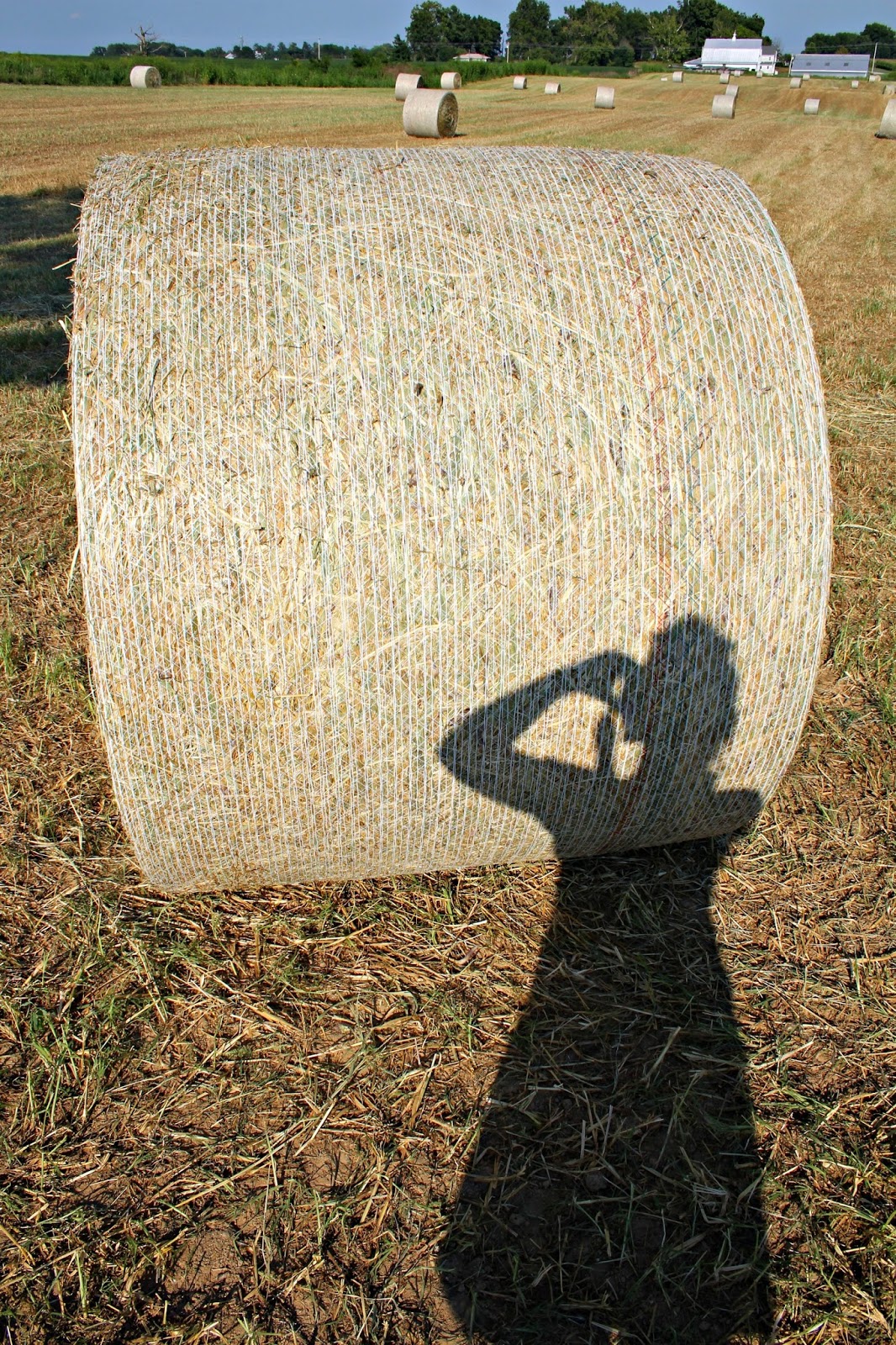
I prefer the smell of fresh cut hay.
And I appreciate my husband for knowing my love and obsession with the beauty of the bales.


There are lots of pretty sites in the country.
One of my personal favorites is the big, round hay bale.
It evokes childhood memories of jumping from one to the other in the barn yard.
It reminds me of watching the cattle run towards the tractor as I rode with my dad to feed them a new, round bale.


While I do love the round bale, I sometimes hate the hay.
It gets stuck on clothes pretty easily so it ends up in my house and on the floors.
It's in the the laundry basket and my washer and in the lint trap.
It's on the floorboards of every vehicle on the farm.
I have found it in my purse, in my hair, in my shoes and stuck to the bottom of my feet.

But hey, that's just part of making hay.


And the reason we make hay and these round bales is to feed the cattle in the winter time.  
This particular field ended up producing 100.5 round bales of hay.
Our cattle herd will go through all 100 of these bales in just one month.

"When you get up to 75 head that weigh around 1100-1200 pounds, 
you have to make a lot of hay," the farmer told me.

And remember, they love when I take pictures of them eating their hay in the winter.


Farmers usually rush to get to the field to cut, rake and bale hay.

You have to make it while the sun still shines because the next day it may rain, 
just like it did the day after these bales were made.


As I was asking the farmer about his hay, he reminded me of a few fun cow facts.

Cows can eat low quality food because of their complex digestive system which includes 
4 compartments in one stomach.

Their digestive system is more efficient in extracting all the nutrients out of the food unlike other farm animals like pigs and chickens which have a simpler digestive system.

They do not bite grass but rather wrap their tongue around it.
Cows are social animals, maybe that's why I love hanging out with them!
And they can only walk up stairs, not down!  


After a hard day's work of makin' hay, the farmer was kind enough to take me to the field to photograph the bales that will feed our cattle in the coming months.  Sitting on top of one of these really makes me feel like I'm on top of the world, again, something I used to think as I child.


And some have asked what they do in the summer. 

Well in the summer, they think about the winter and prepare the food for their cows among other things.  And in the winter, they get anxious about planting their fields and feed their cows that food they prepped and stored in the barn during the summer.


While many of you don't cut, rake or make round bales of hay to feed your cattle in the winter, surely you do something productive before the rain comes.  I hope you finish it and feel good about your work just like the farmer.  And when the rain starts to fall, make sure to enjoy your nap.


Tuesday, February 10, 2015

Love for the Land

This article of mine was first featured in the Farm Indiana publication printed in our local newspaper.  
Enjoy and make sure you appreciate and love something or someone all  year long, not just on the one day this weekend set aside for "love".

****

Love for the Land

Some of us were born with dirt in our blood.  It runs thick through our veins as we live and work on the land that we are so in love with.  It’s hard to explain to people that the smell of dirt and the view of the wide open spaces of farm fields is so beautiful and perfect.  

Farmers have a love affair with their land.  And as we celebrate this month and its made-up holiday, let’s discuss the everyday love affair the farmer has with his land. 


When I was younger I used to just watch my dad as he would drive us from our home on the farm to town.  Even though I trusted him, I always thought we would wreck someday because all he would do was look at his fields.  He was checking the land where he worked alongside his brothers, planted his crops, fixed his tractors, made a living for his family and even lost his wedding ring.  One of the loves of his life, the land, was just as important as going to my basketball games and showing up to see me off to prom.  And as a farm girl, I understood that his love for the land came with making sacrifices and that was okay.  I understand that now as a farmer’s wife too because it’s part of the dedication that comes with this farm life.

My dad, sister and I used to love watching old westerns and the gun fights.  But when it came time for the funerals, dad would turn to us and say, “when it’s my time, don’t use the precious land to bury my body.  Cremate me and give me back to the land.”  And we did just that. 


He loved us so much that he had the forethought to tell us and teach us that land is precious.  He used to say, “You can’t make more land.  What’s there and available is all there is so we have to take care of it.”

I think most of us forget about the blood, sweat and tears that go into one’s love for land.  Think about the many wars, family feuds, and lives lost searching for that small piece of land of their own.  And we cannot forget about the farmers that came before us and the ones today that work hard and care for the land to pass along to the next generation. I am hoping there are many generations to come with dirt in their blood that will continue to cherish and work the land. 


As Scarlett’s father in Gone with the Wind once said, “Why, land is the only thing worth workin', worth fighting' for, worth dying for, because it’s the only thing that lasts."  And he was right, it is the only thing that really lasts and is always beneath our feet.

As you celebrate this month of love, remember that for farmers it’s not all about love for their significant others or families.  This month and every month is about the love for their land.