Header Image map

Home My Story Fancy Things Country Life Great Americans Entertaining Media/PR Contact Me Image Map

Tuesday, September 15, 2015

Class on the Farm

My niece will celebrate her 8th birthday in a few weeks and I'm pretty excited about her gift. 
I recently learned she loves "playing school" just like I did when I was her age!  
So she will be getting a bell, hall passes, workbooks, a grade book and more!  

Obviously I am thrilled because I love back to school shopping!
And I recently wrote an article about how farmers need to "teach" more and 
open their "classrooms", their farms, more to consumers.  

You will see my recent Farm Indiana article below.
If you are a farmer, I hope you teach someone about your farm and
 what you are doing in the fields this fall.

If you are a consumer, I hope you ask a farmer about what he/she does on his/her family farm, in the fields and in the pastures with the animals.  Don't assume, ASK!

I'll be ready to teach you from the field in my backyard or with the cows in the pasture next door.
Ask me if you have questions, I'll have my bell and grade book in hand!

***

When I was younger, I had a school classroom set-up in my parents’ basement and acted like I was a teacher, day in and day out.  Before getting on the bus each morning I would visit my class and tell them that they would have a substitute for the day.  I never grew up to become a teacher, but I find myself “teaching” people about agriculture day in and day out.


I was at a reception lately, enjoying my wine when I encountered a woman who had been given so many myths about agriculture.  I spoke with her briefly and gave her some straight facts when she said, “I feel like we as consumers are so targeted and given so much information, I don’t know what to think anymore.”  I handed her my card and said, “Email me, I really have so much that could help you understand where your food comes from and why we do what we do on our family farms.  I want safe, healthy and affordable food just like you and I live on a farm, so let’s talk.”  I received an email from her first thing the next morning. 

Then I recently had to defend the 4-H program and bacon.  “How can those kids show those animals and become close to them, then sell them and go eat a hamburger or bacon?  I think it’s cruel.”  After taking a deep breath, I explained the 4-H program, hard work, our understanding of the circle of life and providing for others.  I didn’t get through to this person but it made me realize, yet again, that there are many people in this world that don’t understand our way of life and the lifelong lessons that 4-H teaches our children.  Nor do they understand that cruelty isn’t a part of agriculture and that farmers want to provide bacon for everyone’s table, if they want it. 


Most students will go back to school this fall and not have one lesson about agriculture even though much of what they learn is related to ag such as science, chemistry, math and even history.   I have visited classrooms and taught an agriculture lesson to inner city students who had no idea about how to grow a plant or what cows really looked like.  Cows are in my backyard, but these kids don’t even have a backyard to see something grow let alone hear cows each morning. 

We in agriculture have taken our wonderful way of life and our jobs to provide food to the world for granted too long.  We forget that many kids think that chocolate milk comes from brown cows and that brown eggs are better for you.  They think the food at the grocery or Wal-Mart comes from “the back” instead of our families’ fields, barns and pastures of the countryside. 

There is no substitute for our lives as farmers and advocates for agriculture.  And there is no bigger classroom than the one we live in, work in and dedicate our lives to—that of agriculture and our farms that touch every single person.


 So for those of you who are farmers, I urge you to teach.  Educate someone about what you do day in and day out and find some way to apply it to their lives as the everyday consumer who doesn’t live on a farm.  For those of you that don’t farm, I ask that you learn.  Be open to learning about what farmers do and how they care for their animals and their farm.  If you have questions let me know, I’m not leaving my classroom between the corn and the cattle anytime soon.   

Thursday, September 10, 2015

It's a Partnership, Not a Sponsorship

I was traveling for work and play recently and was gone for almost two weeks straight.

When I departed home for my long weeks of work meetings, time with friends and many miles in the air and on the road, I left a lot of sliced peppers.  

And when I returned, the floors were clean and his laundry was done.  


It wasn't a miracle, it's part of the partnership.  
Brett likes fresh sliced peppers to snack or just eat for dinner after a long, hot day.
I hate doing his 10 loads of laundry a week and seeing cow manure in my washer.
I also like clean floors. 

We both know what each other hates and what we like, so we try help each other out a bit in our 
busy lives, and we drink plenty of cocktails along the way.

My husband has always said, 
"Marriage is a partnership, not a sponsorship."

He knows who he married so he has to say that a lot.....but it works!


In order for this partnership to work, he knows to leave his dirty, dusty clothes on the back porch.
And I have learned that they will have to enter my washer.


This partnership works because I have finally realized I may have too many clothes and try to limit my shopping excursions.  But he has learned to just compliment, take a deep breath and shake his head.


We have really learned to embrace our heritage together and that dressing up 
with your partner is better than going at it alone.


We challenge each other to try new things and step out of our comfort zone.

I never would have kayaked.....


....or owned a dog without my husband, my partner.  


My mom always tells me that we are good together because we have our own hobbies and interests, but we also have found many things we can do together like bird hunting. 

Even though this is a good "partnership" activity, somehow he tricked me by buying me a new hunting vest with pockets.  I have pockets, he doesn't which means I have to carry the birds.  

I told him if I have a new vest, I will have to buy other new hunting accessories.
He just shook his head....


As I have just returned from traveling and wrapped up a busy summer, 
he is preparing for a busy fall and harvest.  
Sometimes we have to sponsor each other at different times of the year to make the partnership work.

And as partners, we support each other through thick and thin, the clean and the dirty.


So as I plan to "sponsor" my husband during harvest by making countless sandwiches and cutting lots of peppers, I may shop a little while he is in the field.  And when I return home, I won't mind if the floors are dirty.  Our partnership depends on it!


Tuesday, August 18, 2015

Hay There!

It was Sunday morning, a day we are supposed to spend with the Lord and rest,
when the farmer texted me, "I'm off to rake hay."

"Okay, love you." I responded knowing he wouldn't be home for several hours.

'I'll go nap for the both of us' is what I was really thinking but didn't say.


Later that day he came home right as I was waking up from my Sunday nap.
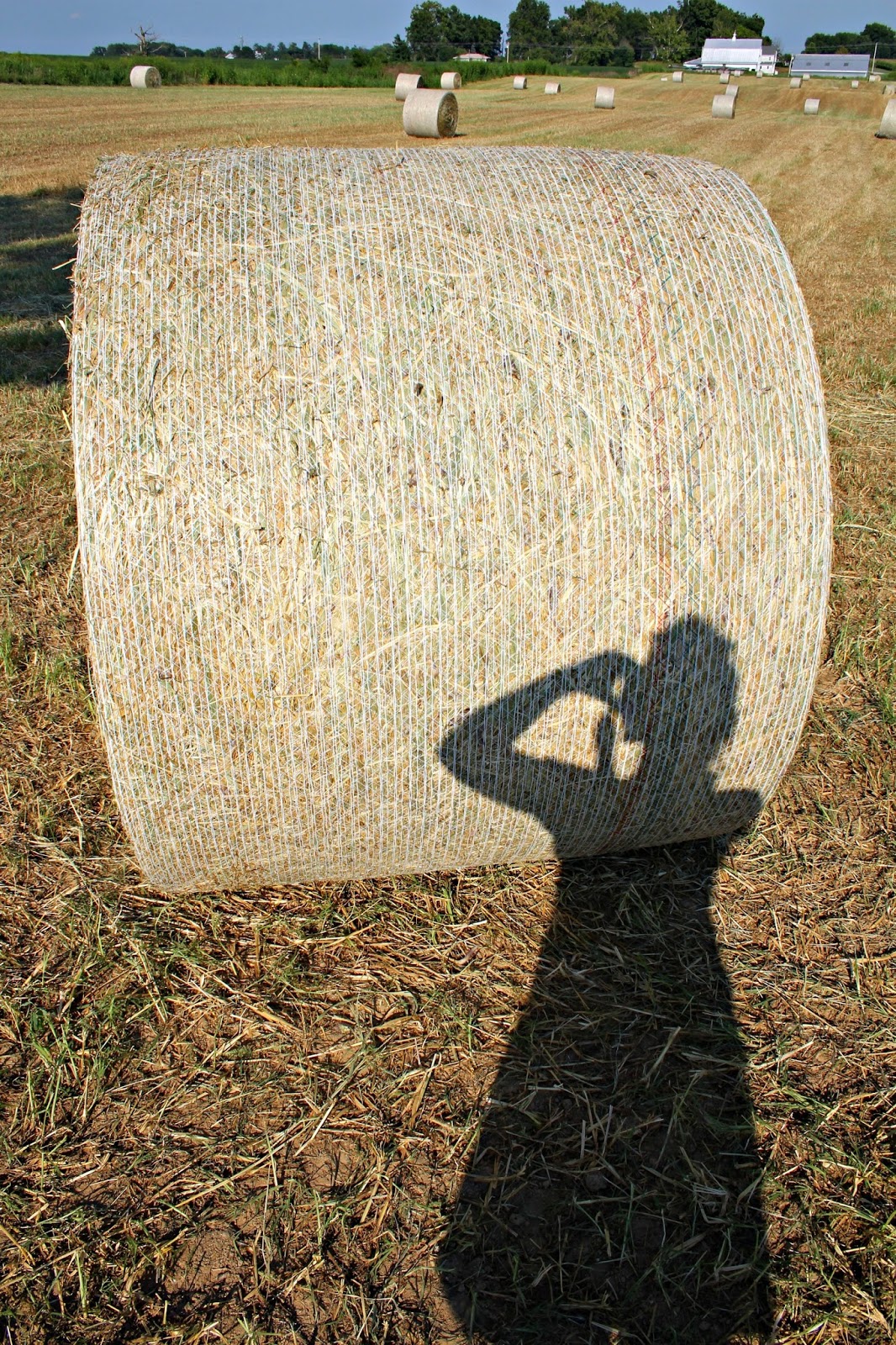
"There are over 100 bales if you want to take some photos," as he walked in the door.
I instantly perked up and ran for my camera and boots!

Some people like the smell of fresh cut grass. 
I prefer the smell of fresh cut hay.
And I appreciate my husband for knowing my love and obsession with the beauty of the bales.


There are lots of pretty sites in the country.
One of my personal favorites is the big, round hay bale.
It evokes childhood memories of jumping from one to the other in the barn yard.
It reminds me of watching the cattle run towards the tractor as I rode with my dad to feed them a new, round bale.


While I do love the round bale, I sometimes hate the hay.
It gets stuck on clothes pretty easily so it ends up in my house and on the floors.
It's in the the laundry basket and my washer and in the lint trap.
It's on the floorboards of every vehicle on the farm.
I have found it in my purse, in my hair, in my shoes and stuck to the bottom of my feet.

But hey, that's just part of making hay.


And the reason we make hay and these round bales is to feed the cattle in the winter time.  
This particular field ended up producing 100.5 round bales of hay.
Our cattle herd will go through all 100 of these bales in just one month.

"When you get up to 75 head that weigh around 1100-1200 pounds, 
you have to make a lot of hay," the farmer told me.

And remember, they love when I take pictures of them eating their hay in the winter.


Farmers usually rush to get to the field to cut, rake and bale hay.

You have to make it while the sun still shines because the next day it may rain, 
just like it did the day after these bales were made.


As I was asking the farmer about his hay, he reminded me of a few fun cow facts.

Cows can eat low quality food because of their complex digestive system which includes 
4 compartments in one stomach.

Their digestive system is more efficient in extracting all the nutrients out of the food unlike other farm animals like pigs and chickens which have a simpler digestive system.

They do not bite grass but rather wrap their tongue around it.
Cows are social animals, maybe that's why I love hanging out with them!
And they can only walk up stairs, not down!  


After a hard day's work of makin' hay, the farmer was kind enough to take me to the field to photograph the bales that will feed our cattle in the coming months.  Sitting on top of one of these really makes me feel like I'm on top of the world, again, something I used to think as I child.


And some have asked what they do in the summer. 

Well in the summer, they think about the winter and prepare the food for their cows among other things.  And in the winter, they get anxious about planting their fields and feed their cows that food they prepped and stored in the barn during the summer.


While many of you don't cut, rake or make round bales of hay to feed your cattle in the winter, surely you do something productive before the rain comes.  I hope you finish it and feel good about your work just like the farmer.  And when the rain starts to fall, make sure to enjoy your nap.


Tuesday, August 4, 2015

Don’t Let Your Tears Hit the Ground

I woke up to lightening on Sunday night and had a flashback 
of the rain and storms from earlier this summer.  

After not hearing any rain fall to the ground, I fell back asleep.

Yesterday morning, I asked the farmer if it had rained and if it was going to.
"It just missed us," he said.
"Do we need it?" I replied.
"I wouldn't turn it down."

There you have it, a month ago we were praying it would stop and I was tearing up every time it rained.  Now it's been just hot enough that we need a little rain for our crops.  
It's always one or the other it seems.  
But as dad always said, "it's just part of it."

Below is my most recent article in Farm Indiana about the rain, my tears and what is just part of this so called farm life that we are so blessed to have.

***


It has stopped, for now.  I’m sure there will be more but maybe the next hour will go by without any and hopefully another hour after that.  I’m talking about the rain, and as I write this I am becoming more anxious each day for our farm, my family’s farm where I grew up, my farmer and all the Indiana farmers I work for. 

Most of the time, rain makes me peaceful and want to wrap-up in a blanket and read a good book.  It makes my flowers grow so I don’t have to water them and puts me to sleep, a nice sleep.  These days, I can’t fall asleep when it’s raining.  And when I fall asleep to rain and wake up to more rain it brings back memories I don’t really like to think about too often.


The rain this year has reminded me of the flood of 2008 which was not only a nightmare but a disaster.  The rain put me to sleep that night, but I woke up to my sister barreling down the stairs yelling “we’re stuck! It’s been raining all night, we are stuck on the hill!”  At that moment, I knew it was bad.  The ground had been saturated from several days of rain before the all night downpour.  Before I opened my eyes, I said a little pray and then headed for the kitchen where I knew my farmer dad would be watching the weather forecast.  He was leaning on the kitchen counter, trying not to sulk in the reality of what was happening.  We made eye contact and he said, 
“Get your boots and jackets, we are going to check the river.” 

As we piled into his truck, rain still hitting the windshield, I was praying it wasn’t that bad.  Surely the river was just out a little, like it usually is and it would be fine.  It was still early June, still time to replant the crops.  But no, the worst had happened.  The creek had turned into the river and the river had turned into the Mississippi.  At no other time in my life had I seen my father’s face look so shocked, sad, upset and angry all at once.  I think it was mostly shock as he said, “Girls, I have never seen it this way.  Not in my lifetime.  I bet some of the old timers haven’t even seen this.”  And he was right, they hadn’t.  We headed back to the farm and stopped at Grandma’s house to tell her.  
She hugged us all and tried to hold back her tears.


That’s what I tried to do then and have been trying to do this summer, hold back my tears for my farmer and my family.  Most people don’t understand though.  I moved from our farm to the city the day after the big flood in 2008.  It was hard for me to leave home during such a disaster, but I closely monitored the damage and recovery from afar that summer while working and living in the city.  When the flood happened and my hometown of Martinsville, along with many others like Columbus, were covered in water, all I wanted to do was return home to help.  I wanted to help my grandma clean up her flooded basement and help families in town that lost their homes to the river.  No one in the city really understood, let alone understood why I wanted to just go “home”.  Well my home was the ground that was flooded and covered in Mother Nature’s tears.

I sent my girlfriends a text recently about how emotional I have been about the weather.  A few of them had no clue, they live in the city.  Memories of 2008 came to mind and tears started to fill my eyes, but I held them back.

What I have learned about farmers in my 29 years of life is that they are resilient, in so many ways.  A flooded field, horrible drought, fluctuating markets, sick animals and accidents on the farm may knock us down but we do get back up.  As my farmer says, 
“we are going to get through it and it’s going to be okay.” 

Our home is the ground we live, work and die on and where our blood and sweat saturate the dirt under our feet. Some tears may fall from our eyes but we don’t let them hit the ground, especially these days when Mother Nature is doing plenty of that on her own.  Those of us that have dirt in our blood understand what my dad used to always say to me, “It’s just part of it”.  
Next year, rain or shine, flood or drought we will get back up.


Tuesday, July 21, 2015

The Stories Along the Back Roads & Dead Ends

We recently celebrated our two year wedding anniversary.

A lot has happened in two years and a lot will happen in the next two years.
Sometimes I can't get over how time flies when you are living life and creating your story.


For our anniversary we stayed in Story, Indiana at the Story Inn.
There's not much in Story, and honestly I think it really only has 2 residents--the owners of the inn.

I had been there a few times for their annual wine festival, for drinks with my once boyfriend now husband and for brunch after delivering a bull in Freetown, Indiana which isn't far from Story.

However, after staying there a few nights and spending days on the front porch of our rented house, there is a lot in Story.  There are lots of stories--ones created from the first settlers back in the early 1800s to the once thriving community that later never recovered from the Great Depression.


Today, Story seems like a paradise at a dead end along the back roads of Indiana.
Hoosiers that know the area, and other guests that have visited Story, understand that dead ends are sometimes the best places to continue your journey and your story.  Bikers, horseback riders, lovers of Indiana history, out-for-a-Sunday drive folks and those that enjoy a quiet, dead end know that Story is the place to visit.


My husband and I had finished our brunch and were wandering around the garden when he turns to me and says, "Let's go on a drive."  My immediate response was, "No, I drive all the time.  I'm sick of the road."

"No" he says, "I want to show you something."  
And that he did.

We hopped in the truck and down the gravel roads to "The Town That Was", Elkinsville, Indiana.  
I wanted to read the sign from the truck but he said, "Get out.  Just believe me."
He knows me pretty well, except that he didn't bring tissues so he must still be learning.


These families had to leave their little town so the federal government could build a reservoir 
for other families and other towns.  

I bawled.  I couldn't handle it.  
Tears were dripping down my face and he was laughing because he knew that I would love to see this and honor these people at this dead end.

I loved this memorial for the people that had to move so other families could have water and now enjoy what many of us in the area know as Lake Monroe.  But what's worse is that they actually didn't really have to move.  Someone miscalculated the elevation levels and the little town didn't need to be evacuated after all!


What I realized on this trip down another dead end road is that we are all a part of each other's story.
These people had to leave their town and so did so many others so that the reservoir could be built.  As a kid and a teenager, I went boating and swimming there and didn't even think about the families that had to leave their homes.  Even though without their stories, those memories wouldn't be a part of my story.

We headed down the road and came upon this house.  
I was staring at this once beautiful home with this fence and the open gate when I heard, "Those flowers are annuals.  Someone had to come and plant those and probably does every year." 
Again, I lost it, realizing that someone was trying to continue 
to honor the story of the residents that once lived here.


We turned down another road, and yet another dead end. 
An abandoned bridge that once connected one town to another and neighbors to neighbors.


There were stories on one side and on the other.  
And I wondered how many stories were created on that bridge too.


When I was in D.C. last week, I sat in a meeting room of the National Museum of American History discussing the new exhibit American Enterprise.  My fellow farmers and agriculture advocates were meeting with the exhibit curator about incorporating agriculture into the exhibit today and what it may look like in the next 20 years (the length of the exhibit).  I realized that my conversations were going to influence him to tell our story, the farmer and agriculture story, for generations to come just like those featured in the exhibit have influenced my life, my story.


I was also advocating for agriculture and our farm businesses and way of life while I was in D.C.
Two days later, I was at county 4-H livestock auction realizing my story, my advocating, was going to affect the kids in the arena and the way they live out their stories.


As I reflect on the past two years and appreciate all those memories and stories, I always try to remember where it all started.  It was the day when we signed on the line and committed to a lifetime of stories together while my grandma looked on, her story leading to mine and mine to the next.


And I have always known that each one of us is connected to each other through some story.
Sometimes we just need a reminder so we remember to not forget "The Town That Was" and the lives that were.


So here we are, starting our adventures down the back roads of the next two years of our story together.  While he drives us, I'll write it all down.  And I think he has learned to bring plenty of tissues along, especially to the dead ends with all the great stories. 


Tuesday, July 7, 2015

A Farmer's Wife's Worries

In high school, a friend of mine used to say, 
"Katie, worrying is like a rocking chair: it gives you something to do but never gets you anywhere."


Well, he was right.  I used to worry all the time and it never got me anywhere.
And I'll admit, I still worry a lot now (thanks to that gene from my mother).
I think it's a natural instinct for women to worry especially for the the women who husbands have one of the most dangerous jobs in our country--working in agriculture. 

The timing of this blog couldn't have been more perfect because yesterday I worried that my husband got into an accident.  He hadn't responded to my text for a few hours and didn't answer my call.  I kept thinking of the rocking chair and just told myself to "get home".  As soon as I thought of something else, he called.  
(This happens every time I worry....)

I worry a little when he checks the cows because you never really know what kind of mood they may be in.  And tonight, he got a call, "the cows are out!"  He dropped his book and ran to check them, leaving me slightly worried. 


I worry about him when he has to check cows and fix their frozen water in below zero temperatures.  And then I worry that he's losing his mind when he comes home from being outside all day and says, "let's make snow!'  


I worry about the test plots they he and his brother plant and that the results will be everything they had hoped for.


I worry when I come home to muck boots and clothes on my back porch and think, 
"what really went down in that pasture today and who won?" 


I worry that the equipment will work when it's supposed to during planting and harvest. 


And when I visit the field I usually worry that they haven't worn sunscreen all day and 
that they don't have anything to drink.  

I worry about if they have eaten enough during the busy times and then scramble to make them meals, then worry if it was enough and if they liked it.


This spring and summer I worried so much about the rain that would never end, that I couldn't sleep at night.
Some nights I went to bed while it was raining and woke up to the same rain pouring down from the sky.  But as I laid in bed, there really was nothing I could do but think about it.  The worry wasn't getting me anywhere.

But mainly I worry that my farmer will get in and out of his tractor safely.  
That he will tend to his land and animals and they will return the favor and care for him too.


I really try not to, but I worry too much (obviously).

My farmer, on the other hand, worries little and assures me everything will be okay in the end--it usually always is.

The best thing about him, is that I really don't need to worry about him 
especially when he still wants to sit in the rocking chairs with me after all that worry.


Thursday, July 2, 2015

Summer Vacation Lesson from the Farmer

 Summer is here which means family vacations for some of us and 4H projects for others.  If you were blessed to take a summer vacation and have 4-H projects, consider yourself lucky.  Free time on the farm doesn’t come around for some of our farmers or their families which means no vacation time.  However, staying home and learning about the various lessons from your 4-H projects can be an adventure as well.       


As a kid, we camped a lot with our friends around the state but didn’t take too many long summer vacations.  My mom would take us on our fancy trip to Chicago, “the big city”, to shop while the farmer stayed home for the harvest.  I am sure he was just fine staying home and away from the city and our shopping shenanigans, so it all worked out. 

The one time he went with us on a Spring Break trip to Gulf Shores, Alabama, I never really wanted to vacation with him again.  I was in the 5th grade and we were going with a big group of people to experience new adventures and to relax on the beach.  However, if you know farmers, they can’t really sit still. 

I was elated to stay in a condo with a view of the beach and surrounded by the noise of the big, blue waves.  However, the farmer had something else in mind for us on vacation.  We had to see the army bases and battleships.  It was not an experience this Midwestern farm girl that lived between the cows was expecting to have on her “vacation” to the beach. 

We even had to cut our trip short and head back to Indiana because my farmer dad noticed the corn sprouting from the fields in Alabama.  He got antsy, couldn’t sit still and had to get home to start planting.  I think I even started my 4-H projects earlier that year too. 


As time has gone on and I have traveled around the world, I think about that summer vacation and the time we spent learning about the history of our country and those that served on the battlefield.  I now understand that dad took us on adventures through the battleships to teach us something and why we were able to enjoy our vacations.  He taught us that it’s okay to sit on the beach and relax for a short time, but vacations should include life lessons just like those 4-H projects left behind to finish.  Even though I was mad we came home early, I think I earned more blue ribbons that year—lesson learned.


So take that summer vacation to sit still and relax for a moment!  But remember to learn a lesson or two while you are away from the farm or your home.  Enjoy that freedom to travel and be adventurous and give thanks for the lessons they teach you, maybe you’ll get a blue ribbon too.